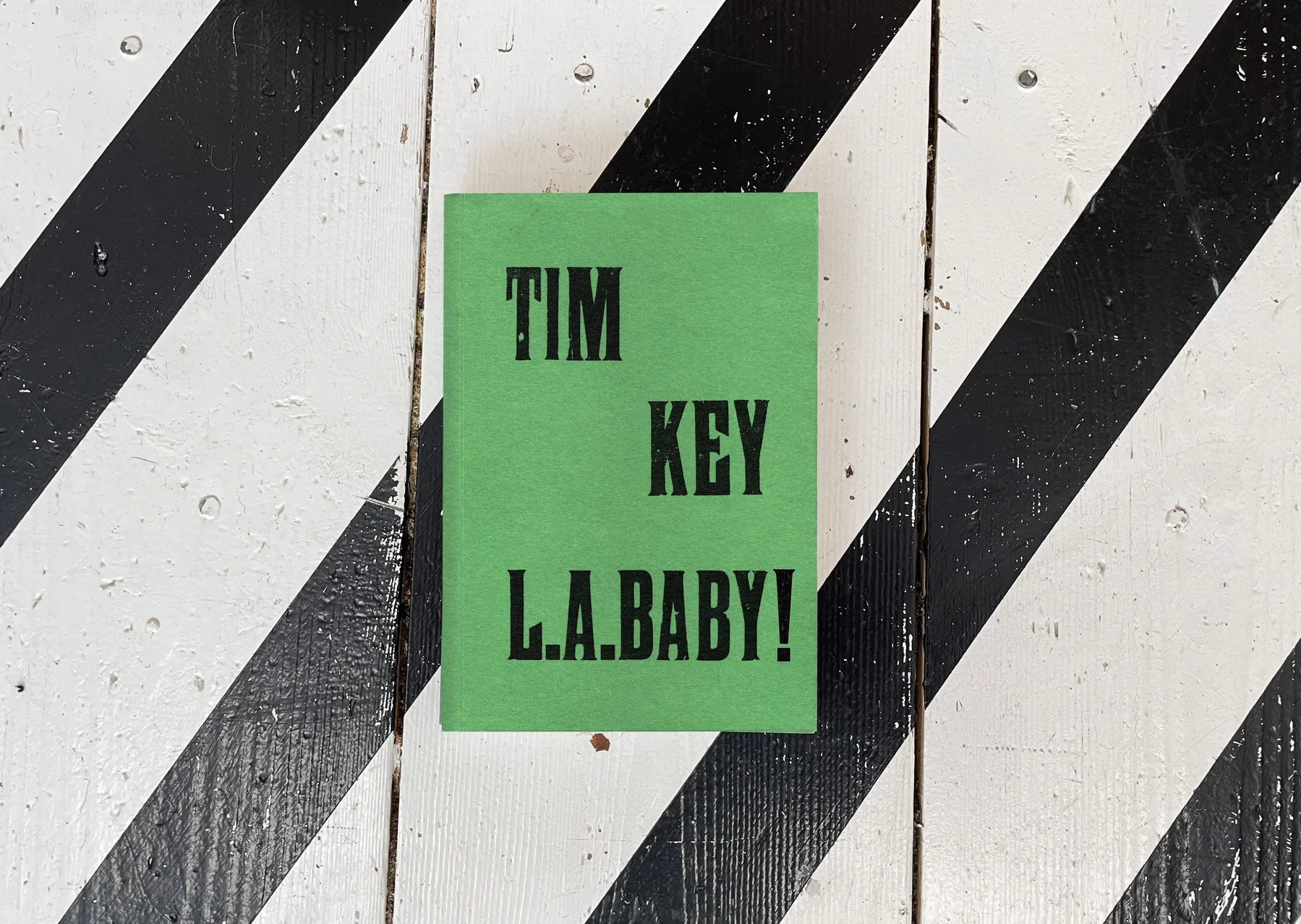
L.A. Baby! is a poetry collection by English actor-comedian-writer-poet Tim Key which, with its focus on Los Angeles, was timely published on American Independence Day 2025.
Key had been busy since his previous collection, 2024’s Chapters; you may have seen him performing in feature films Mickey 17 and The Ballad of Wallis Island (for the latter he was also co-writer and executive producer). He also appeared on television in How are You? It’s Alan (Partridge), New Zealand Spy and The Paper.
For The Paper he worked in Los Angeles, which is how these poems came into existence i.e. they were inspired by his trip and fictitiously document an English actor’s life in L.A.
And there are poems aplenty, with over 70 packed in to ten sections detailing our anti-hero’s three month experience from start to finish – at the airport, his arrival in a strange land, jet leg, an actor’s preparation and life on set, a road trip and going back home. The poetry is interspersed with what is effectively a running commentary on the action between Key’s long-term collaborator publisher, the intrepid Emily Juniper (“Utter” & Press), who has excellently designed and illustrated the book; of particular note is its’ ingenious sleeve which ensures that the collection can squeeze in an additional “starter” poem and a closing “bonus” commentary.
Overview
Readers of Key’s earlier collections will be both pleased and appalled that many of the poetic pre-occupations continue. Very quickly we discover that the protagonist (although “protagonist” may be over-egging the pudding) still journeys with his House of Games carry-on suitcase (“Plenty of Time”). He perves at the Woolacome zip-through hoodies in FatFace, chomps through Toblerone bars and drinks heavily, He is adrift in a new world without his favourite retailers WHSmith (“LAX”) and his beloved sandwich emporium Pret A Manger (“Life Goes On”) – surely by now Key merits a lifetime free supply of Swedish meatball hot wraps, or his choice of substitution, for the longstanding endorsement.
We don’t think that it’s an overstatement to say that these pre-occupations are now so strong that they have become talismanic, Gatsby’s green light at the end of the dock, with the Pret sign romantically shimmering like a star (“Arrivals”) at the close of the collection.
L.A Baby!
Despite the triumphant proclamation of the title (taken from the alter-ego’s declaration to a “clearly impressed” but more likely puzzled shop assistant in the “The Prongs.”), this is the story of a fish out of water, an Englishman struggling in a foreign country. As he steps out of the plane a flood of American symbols sweeps through his head, “the United States of America came at me like a fucking hairdryer” (“Welcome to America”).
As such this is perfect territory for humour. Our character initially prowls around his unknown new territory like a wild animal (“Cat”) and expects immediate A-lister friends – Hoffman, Stallone and Luke Skywalker amongst others (“Reaching Out”). We see him practising his American language skills with a bemused barista (“Dialect”) and making the most of jetlag and the time difference, taking pleasure in waking up his London associates (“Nocturne”).
The setting gives Key the opportunity to focus on culture shock and the differences between two countries that do not speak the same language. In his lemon-coloured linen suit, our anti-hero increases and intensifies in his Englishness through being away from Blighty (“An Englishman in L.A”).
His homeland becomes mythical in its absence as he longs for things he identifies with home – Wallace and Gromit, Des Lynam, Nottingham Forrest (“Green and Pleasant”). He struggles to keep up with the rules of baseball in “The Ball Game”. He encounters different meanings in language (“Lost in Translation”) and an English accent becomes unexpectedly advantageous (“How Do You Do”) with the character stretching the characteristics of his nationality to the extreme.
Food glorious food, and a few drinks
It would be remiss not to mention the strict dietary regime required of an actor. Our man in the field is taken aback by American food – mostly the quantity/delivery methods – but gives it a good go. One option presented to him in an American café menu of “What’ll It Be?” is the “Baja Breakfast Burrito” featuring “farm-fresh scrambled eggs, guacamole, cherrywood bacon, Tillamook Cheddar Jack cheese, pico de gallo, served with tortilla chips”.
Another time he is “hosed down” with milkshake at McDonald’s (“Drive-Thru”), and also devours on-set catering “like the most disgraceful hog you can imagine” (“Lunch”). He loses more than his shirt in “The Tipping Culture” all for a Modelo Negra, and knocks back tumblers of vino, “litres of this crap”, at a Californian winery (“Napa”).
L.A. as a city/Hollywood
L.A. as a city is artfully evoked, with the “incessant clunking of MacBook Airs” in cafés (“The Writers). There’s a lurid roller-blading experience at Venice Beach in “Life’s a Beach” and trouble with self-driving cars in “The Future”. Our man throws himself into an array of local pursuits in “A Valuable Member of Society”.
Hollywood and the world of acting are also expertly taken on. He brushes up on acting technique “(The Basics” and “Marlon”), asks advice from Stan Laurel when he runs into him on La Brea (“A Friend In Need”), flirts with aspiration in “Everyone’s an Actor” and witheringly calls his agent in the heat (“Lava”). He has a difficult professional relationship with a colleague who starts out as “some mild-mannered yank” but grows in confidence to attempt to steal his job and life in “The Stand-In”.
Throughout we encounter the iconography of the movies. “Famous Names” reels off a list of disparate individuals such as Larry David, Harold Lloyd, Desperate Dan, Mae West and Gentle Ben. Juniper asks in the commentary what this is all about. She’s given various answers to link the people – they are “absolute humdingers”; they are elusive; he took selfies with them.
Key excels at subverting the established view of American culture – Audrey Hepburn/Holly Golightly is inserted into an unlikely scene on a horrifying date involving crack and root beer (“Fancy Coming to the Pictures with Me?”). On a pilgrimage to Marilyn Monroe’s bungalow (“Norma Jeane”) an entirely unexpected vision of Monroe is presented to us which is unforgettable in its precise imagery.
Comedy and Hummingbirds
Yes, we’re trying not to give away the whole caboodle so as not to ruin the spectacular comedy. The poems benefit from Key’s willingness to always push the character further, and provide an underlying warning that most of us are usually just one step away from being slightly ridiculous. Our man sings a song about premium economy to his fellow travellers on the plane in “Song to Whoever”. He is spotted by a model agency but plays hard to get (“Spotted”). He drunkenly admires his own showreel in “An Education”, and there’s a highly inventive bathtub episode in “Shake”.
There are also some more serious poems, and they are impressive. There’s a sad moment of grim self- reflection in “The Hunched Figure”. We witness an election day “soaked in doom” in “A Nation Decides”, and “Go Dodgers!” takes us to a city on the verge. “Perspective” asks in bewilderment, from the position of staring up at the stars in the planetarium: “Why tell people they’re insignificant? We all find out soon enough, no need to ram it down our throats.”
L.A. Baby! and Key’s work more generally show that when the stars do align there can be a strong connection between comedy and poetry due to a shared focus on language and rhythm. Further, Key excels in both disciplines, so his work should easily convince any comedy fan who has been previously sniffy about “high brow” or “elitist” poetry. It’s a good place to leave you with this image from “A Sporting Life”. Imagine our hero immersed in nature at dusk, running around the Hollywood Reservoir and the “well-to-do hillside cottages of the hard-working stars of the silver screen”. I don’t know about you, but I take comfort in that; it’s good knowing he’s out there –
Hummingbirds could be heard reversing, their beats wet
with nectar.
As I rounded the corner and slid onto the start of the gradual
incline that would eventually take me up to the reservoir
itself, I shat myself, and then I wandered back.
“UTTTER” & PRESS
BUY UK
BUY US
LIKE 4 MORE CONTENT

Publisher: “Utter” & Press
Publication Date: 4 JUL 2025


Leave a Reply